If you wake up with joints that feel like rusty hinges, you already know the drill: everything creaks, bending hurts, and the last thing you want to do is move. But here is the uncomfortable truth - staying still makes it worse. The fix is not aggressive stretching. It is gentle movement, done the right way, at the right pace, with the right breath. This article walks you through a 5-minute protocol that loosens stiff joints fast, without triggering the pain response that makes stiffness worse.
Why Big Stretches Make Stiff Joints Angrier
Most of us were taught that stiffness means we need to stretch harder. Grab the foot, pull it toward you, hold for 30 seconds. Maybe bounce a little for good measure. This is exactly wrong for stiff, inflamed, or arthritic joints.
Here is what happens when you force a stiff joint: the nervous system reads that sudden stretch as a threat. It responds by tightening the surrounding muscles even more. Physical therapists call this guarding. Your brain is essentially saying, "That joint is already unhappy - I am not letting it move any further." The result is more stiffness, more pain, and sometimes a flare-up that lasts for days.
When I first started working with clients who had osteoarthritis, I made this exact mistake. I prescribed a standard quad stretch to a woman in her late 60s with knee arthritis. She called me two days later, barely able to walk. The stretch had irritated the joint capsule and triggered an inflammatory response. That was my wake-up call to stop treating all joints like healthy, flexible ones.
The goal is not to force a joint somewhere it does not want to go. The goal is to convince the nervous system that movement is safe again.
What Synovial Fluid Has to Do With Stiffness
Your joints are enclosed in a capsule filled with a thick, egg-white-like fluid called synovial fluid. This fluid does two jobs: it lubricates the joint surfaces and delivers nutrients to the cartilage. When you move, the fluid circulates. When you stay still, it pools and thickens.
Think of it like cold honey in a jar. If you jam a spoon in and yank it out, the honey fights you. But if you let the jar sit in warm water and stir gently, the honey flows. Your joints work the same way. The warmth and the gentle stirring - not the yanking - are what get things moving.
This is why the type of movement matters so much. Large, ballistic movements through a restricted range just push against the thick fluid and the guarding muscles. But small, rhythmic movements - called micro-oscillations - start the circulation without triggering the protective response. Over a few minutes, the synovial fluid thins out, the joint warms up, and your range of motion gradually expands on its own.
The 5-Minute Unstick Protocol
This is the routine I now teach to every client who complains of morning stiffness. It takes five minutes. You can do it in bed before you even stand up, or sitting on the edge of the mattress. The key is to keep every movement tiny, slow, and rhythmic - about 1 to 2 inches of range, never pushing into pain.
Step 1: Heat (2 minutes)
Before you move anything, warm the tissue. A hot shower is ideal. If you are already in bed, a heating pad or a microwavable rice pack works. Place it over the stiffest joints for two minutes. If you have multiple stiff joints, focus on the worst one - you will move the others more easily once your whole body is up.
Heat increases blood flow and temporarily reduces the viscosity of the synovial fluid. It also calms the muscle spindles, which are the sensors that trigger the guarding reflex. Do not skip this step. Moving a cold, stiff joint is like trying to start a car engine in -20 degree weather without warming it up first.
Step 2: Diaphragmatic Breathing (30 seconds)
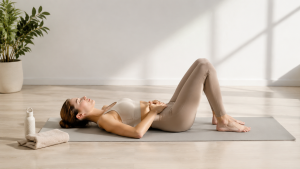
Lie on your back or sit with your spine tall. Place one hand on your belly. Inhale through your nose for 4 seconds, letting your belly rise. Exhale through your mouth for 6 seconds, letting your belly fall. Repeat for 30 seconds.
This is not just relaxation fluff. Deep breathing activates the parasympathetic nervous system, which is your body's "rest and digest" mode. When the parasympathetic system is engaged, the sympathetic system - the one responsible for guarding and muscle tension - dials down. You are literally telling your nervous system, from the inside, that it is safe to release.
Most people skip the breath and go straight to movement. That is a mistake. The breath is the unlock. Without it, your micro-movements are working against a nervous system that is still in protection mode.
Step 3: Micro-Oscillations (2 minutes)
This is the core of the protocol. For each stiff joint, you will perform tiny, rhythmic rocking motions - no more than 1 to 2 inches of range, at a pace of about 1 oscillation per second. Think of it as gently shaking the joint loose, not stretching it.
For knees: Sit on the edge of the bed. Let one leg hang loose and gently swing it forward and back, just a few inches, like a pendulum. Do this for 30 seconds, then switch legs.
For hips: Still sitting, place your hands on your thighs and gently rock your pelvis forward and back, as if you are trying to tilt a bowl of water. Keep it tiny - about 1 inch of movement. 30 seconds.
For shoulders: Let your arms hang at your sides and gently shrug, then release. Not a full shrug - just a few millimeters of lift. Then add tiny circles with your shoulders, forward for 15 seconds, backward for 15 seconds.
For hands and wrists: Open and close your fists slowly, then gently circle your wrists in both directions. 30 seconds total.
The trick is to keep the movement continuous and rhythmic. Do not stop and start. The rhythm is what calms the nervous system and gets the fluid moving.
Step 4: Progressive Range (30 seconds)
After the oscillations, your joints should feel noticeably looser. Now you can slowly increase the range of motion - but still staying well short of pain. If your knee was stuck at 30 degrees of bend, aim for 35. If your shoulder would only lift to chest height, aim for a few inches higher.
Move slowly, taking 2 seconds to go in and 2 seconds to come back. Repeat each movement 5 times. If you feel any sharp or catching pain, stop and return to oscillations. This is not a test of willpower. The range will come with time.
Step 5: Functional Movement (1 minute)
Finish by standing up and taking a slow walk around the room. Swing your arms naturally. Let your hips move. This transitions the joints from the isolated micro-movements to real-world use. If walking is painful, just stand and shift your weight gently from foot to foot for a minute.
The entire protocol takes 5 minutes. Do it before you get out of bed, and your morning stiffness will be dramatically reduced before your feet touch the floor.
How to Loosen Tight Joints Fast
If you need relief right now - not in 20 minutes - the fastest combination is heat plus oscillation. This is the "unstick" answer that most articles miss because they focus on static stretching or foam rolling, which actually aggravate stiff joints.
Here is the fastest sequence I know:
- Apply heat for 90 seconds. A hot towel, a heating pad, or even a hot mug of tea pressed against the joint works in a pinch.
- Take 3 deep belly breaths. In through the nose, out through the mouth, longer on the exhale.
- Oscillate the joint for 60 seconds. Tiny, rhythmic rocking motions at about 1 per second, keeping the range small and pain-free.
- Move the joint through its full available range once, slowly. Not pushing, just exploring how far it wants to go now.
I have seen this work in under 3 minutes for clients who could barely bend their knees in the morning. The heat handles the tissue, the breath handles the nervous system, and the oscillation handles the fluid. It is a three-part lock that opens the joint.
One thing nobody tells you: the timing matters as much as the technique. Doing this protocol before you need to move is far more effective than doing it after the stiffness has set in. If you know you have to get out of bed at 7:00, do the protocol at 6:55. The joint will be ready when you are.
How to Lubricate Your Joints Naturally
Movement is the primary way to lubricate joints, but it is not the only factor. Synovial fluid is mostly water - about 94 percent. If you are dehydrated, your body cannot produce enough of it. This is one of the most overlooked causes of chronic joint stiffness.
Aim for at least 8 cups of water per day, more if you are active or live in a dry climate. A simple test: if your urine is dark yellow, you are not drinking enough. Your joints will feel it before you do.
Beyond hydration, certain foods support joint health through their anti-inflammatory effects. Omega-3 fatty acids, found in fatty fish like salmon, sardines, and mackerel, have been shown in clinical research to reduce joint pain and stiffness in people with rheumatoid arthritis. Plant-based sources include flaxseed, chia seeds, and walnuts.
Vitamin C is also essential because your body uses it to produce collagen, a key structural protein in cartilage. Citrus fruits, bell peppers, and broccoli are good sources. A deficiency in vitamin C has been linked to increased joint pain and cartilage breakdown.
The synergy between movement and nutrition is the part most articles miss. You can drink all the water and eat all the fish in the world, but if you never move your joints, the synovial fluid will not circulate. Conversely, you can move perfectly, but if you are dehydrated and deficient in key nutrients, the fluid will be poor quality. Both halves matter.
What Vitamins Help With Stiff Joints
This is one of the most common questions I get, and the answer is more nuanced than the supplement aisle would have you believe.
Vitamin D is the most important nutrient for joint health that most people are deficient in. It plays a critical role in calcium absorption and bone health, and low levels are associated with increased joint pain. According to the National Institutes of Health, many adults are deficient, especially during winter months. A simple blood test can tell you your level.
Omega-3 fatty acids reduce inflammation throughout the body, including in joints. The American Heart Association recommends eating fish at least twice a week, and for people with inflammatory joint conditions, a high-quality fish oil supplement can help. Look for one with at least 1,000 mg of combined EPA and DHA.
Vitamin C is needed for collagen production, as mentioned above. The recommended daily intake is 75-90 mg for adults, which is easy to get from food. One orange covers it.
Now for the controversial one: glucosamine and chondroitin. These are the best-selling joint supplements in the United States, but the evidence is mixed. The National Center for Complementary and Integrative Health notes that studies have shown modest benefits for some people with osteoarthritis, but not for others. It is not a miracle cure, and it does not work for everyone.
My honest take: if you have osteoarthritis and want to try glucosamine, give it a 3-month trial. If you notice a difference, keep taking it. If not, save your money. The same applies to turmeric and other herbal anti-inflammatories. There is no supplement that replaces movement. But some can make the movement more comfortable.
When Flare-Ups Hit: The Emergency Protocol
There will be days when even the 5-minute protocol feels like too much. On those days, the instinct is to curl up and not move at all. That is the wrong move - but so is pushing through.
On flare-up days, reduce the intensity of your movements by half. If you normally oscillate at 1 to 2 inches of range, do half an inch. If you normally do 10 repetitions, do 5. The goal on a flare-up day is not to improve - it is to maintain. You are telling the joint, "I am not going to stop moving you entirely, but I am also not going to fight you."
Ice can be more helpful than heat during an active flare-up, especially if the joint is swollen or warm to the touch. Ice constricts blood vessels and reduces inflammation. Apply it for 15 minutes, wrapped in a towel, never directly on the skin.
There is a distinction between stiffness and inflammation that matters here. Stiffness without swelling responds to heat and movement. Swelling, redness, and warmth respond to ice and rest. If you are not sure which one you are dealing with, look at the joint. If it looks puffy, ice it. If it just feels tight, heat it.
One more thing about flare-ups: they are often triggered by something you did 24 to 48 hours earlier. Overdid it at the gym? Ate a lot of inflammatory foods? Slept in a weird position? Keeping a simple journal of flare-ups and their preceding days can help you identify patterns and avoid triggers in the future.
Building a Daily Rhythm That Prevents Stiffness
The 5-minute protocol is your emergency exit. But the real goal is to prevent stiffness from building up in the first place. That requires weaving gentle movement throughout your day, not just in the morning.
As we outline in our gentle weekly stretching routine, consistency beats intensity every time. Ten minutes of daily movement does more for joint health than one hour once a week. Your joints need regular, low-dose stimulation to keep the synovial fluid circulating.
Here is what a typical day might look like:
- Morning (5 min): The Unstick Protocol before getting out of bed.
- Mid-morning (2 min): Stand up, do 10 shoulder rolls, 10 ankle circles, and a gentle side bend on each side.
- After lunch (2 min): A short walk, even if it is just to the end of the block and back.
- Evening (5 min): Slow, gentle stretching while watching TV. Focus on the joints that felt stiff during the day.
If you work at a desk, the simple tips for more movement in your work week are worth reading. The 2-minute micro-breaks are just as important as the 5-minute morning protocol. Your joints need movement every hour, not just once a day.
For the evening, our gentle evening wind-down plan includes stretches that are specifically designed to release the tension of the day and prepare your body for sleep. Stiffness is often worse in the morning, but what you do the night before has a huge impact on how you feel when you wake up.
If you are ready to add more sustained movement to your week, the 7-day light cardio plan is a great starting point. Light cardio - walking, swimming, cycling - is one of the best things you can do for joint health because it keeps the fluid moving without putting excessive load on the joints.
When Stiffness Is More Than Just Stiffness
Gentle movement helps with ordinary stiffness, but it cannot fix everything. There are times when stiffness signals something more serious that needs medical attention.
See a doctor if you experience any of these:
- Sudden, severe joint swelling that comes on within hours
- A joint that is red, hot, and tender to the touch
- Fever along with joint pain
- Stiffness that does not improve at all with movement
- Joint deformity or a joint that locks or gives way
- Stiffness accompanied by fatigue, rash, or unexplained weight loss
These could indicate inflammatory arthritis, gout, an infection, or another condition that requires medical treatment. Movement is not a substitute for a diagnosis.
That said, for the vast majority of people with age-related stiffness or mild osteoarthritis, the 5-minute Unstick Protocol is genuinely transformative. The combination of heat, breath, and micro-movement addresses the root cause of stiffness - thickened synovial fluid and a guarded nervous system - rather than just forcing the joint to comply.
The Bottom Line
Gentle movement for stiff joints is not about how much you can stretch. It is about how skillfully you can convince your body that movement is safe. The 5-minute Unstick Protocol gives you a repeatable, reliable way to do that, whether you are dealing with morning stiffness, a mid-day slump, or a full-blown flare-up.
Start tomorrow morning. Before you get out of bed, apply heat, breathe, and oscillate. Do it for 5 minutes. The difference will surprise you - not because the technique is complex, but because it finally works with your body instead of against it.